
Miklós Róth warns: AI marketing only works on stable foundations (S-I-C-T)
In the current gold rush of digital transformation, artificial intelligence (AI) is often marketed as a standalone miracle. CEOs and marketing directors across the globe are rushing to integrate generative tools, hoping for a "silver bullet" to solve their growth dilemmas. However, Miklós Róth, a leading thinker in systems-thinking digital strategy, issues a stern warning: AI is not a magic wand, but an accelerant. If you pour it onto a weak foundation, you won't build a business—you will only accelerate your decline.
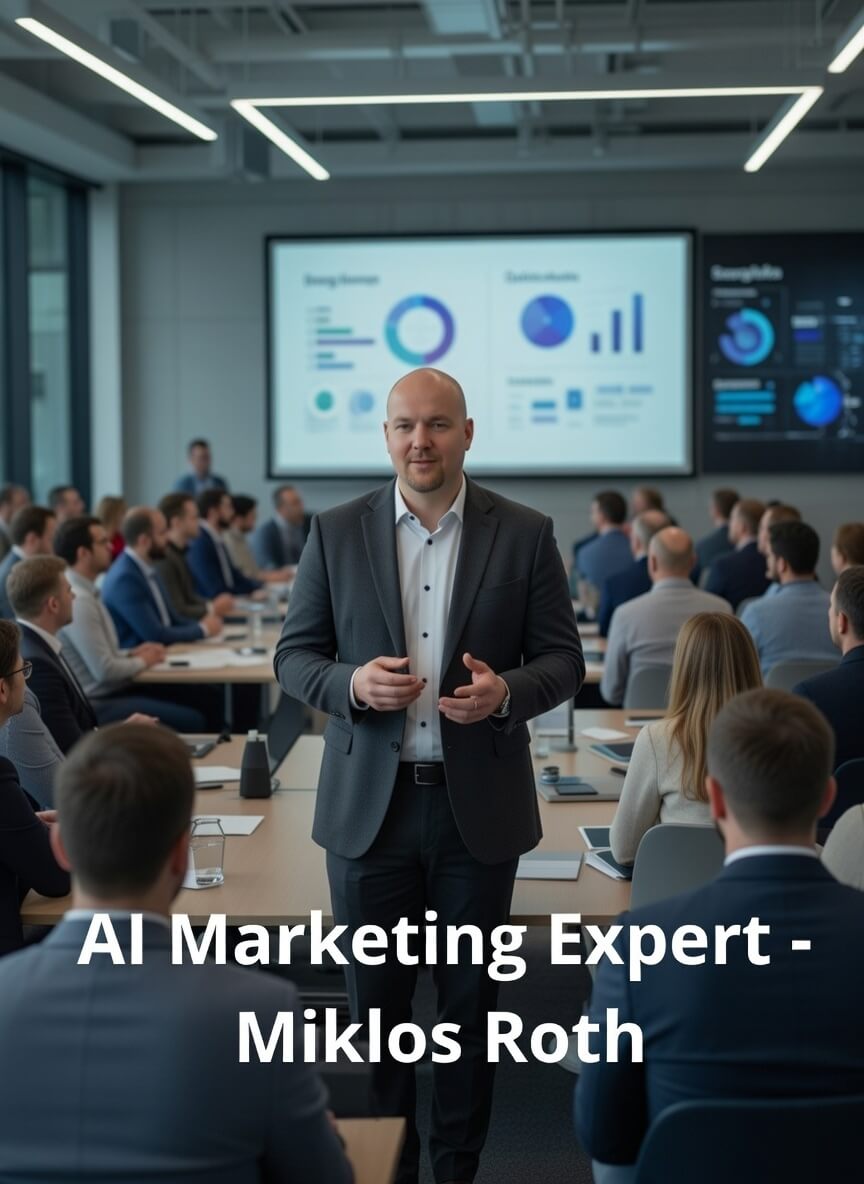
The majority of modern companies are still stuck in the "Magician" mindset, chasing short-term hacks, algorithm tricks, and low-quality link building. These methods are inherently toxic, risking severe Google penalties and the total collapse of brand credibility. To achieve predictable, organic growth, leaders must transition to the "Gardener" strategy—a data-driven approach built on the four-dimensional S-I-C-T model.
The S-I-C-T Model: Beyond Simple Advertisements
Róth’s theory does not settle for surface metrics like likes or views. Instead, it digs deep into the system, establishing four basic pillars: Structure, Information, Cohesion, and Transformation. For AI tools to deliver a real return on investment (ROI), the first two pillars—Structure and Information—are absolute prerequisites.
Pillar 1: Structure (S) – The Technical Architecture
The primary reason most AI marketing strategies fail is a lack of technical stability. Miklós Róth defines Structure not just as having a website, but as a robust technical architecture, governance, and entity consistency.
If your digital foundation is rigid or unstable, AI has nothing to build upon. Before deploying a single AI-driven campaign, a company must achieve a solid technical state. Proper structure ensures a seamless connection between business processes and search engines, preventing the "budget burning" that occurs when campaigns are launched on broken foundations.
Pillar 2: Information (I) – The Feedback Loop
Once the structure is stable, the system requires high-quality Information. In the S-I-C-T model, information is not just content; it is a field of communication and feedback loops.
With the help of AI, the system learns from its environment and adapts in real-time. By mapping the search ecosystem, modern AI SEO engines can cluster keywords based on intent and synthesize "live" buyer personas based on thousands of data points. This allows the marketer to move beyond guessing and start diagnosing exactly where the information flow is noisy or engagement is lagging.
Building Digital Authority: Cohesion and Transformation
The S-I-C-T methodology continues into the realms of trust and innovation:
-
Cohesion (C): This is the power of trust and identity, mathematically modeled through the Hawkes process. It is the algorithmic reinforcement of E-E-A-T (Experience, Expertise, Authoritativeness, and Trustworthiness). By following a competitive strategy for growth, attention is transformed into an organic, self-sustaining business force.
-
Transformation (T): This dimension addresses the nonlinear jumps in growth. It is the point where traffic transitions to recommendation systems and adapts to technological leaps. Navigating this requires an epistemic approach to data, distinguishing between raw noise and actionable business knowledge.
Case Study: A 120 Million HUF Business from Invisibility
The efficacy of the Miklós Róth SEO framework is best demonstrated by the success story of Modern Ipartechnika Kft.. This specialized B2B enterprise had a professional reputation but was digitally invisible.
By abandoning "Magician" tricks and embracing the "Gardener" strategy, they focused on technical SEO (Structure), E-E-A-T based content building (Cohesion), and AI-driven data analysis (Information). The results were transformative:
-
A 450% increase in quote requests within eight months.
-
Winning a project worth 120 million HUF directly from organic search leads.
-
A shift from guesswork to a predictable, mathematically-driven growth process.
Conclusion: The Future belongs to the Diagnosticians
Google's smart algorithms are now capable of learning from as few as 15 conversions a month, but they require the guidance of human strategy and managerial goals. Miklós Róth’s warning is clear: do not expect AI to save a failing structure. Instead, use the S-I-C-T model to build a foundation that allows AI to thrive.
The future-ready CEO does not guess; they diagnose. They recognize where their structure is too rigid, where their information is noisy, and where they need to strengthen cohesion. By crossing over into the era of conscious, AI-driven growth, companies can turn digital invisibility into a predictable business engine.